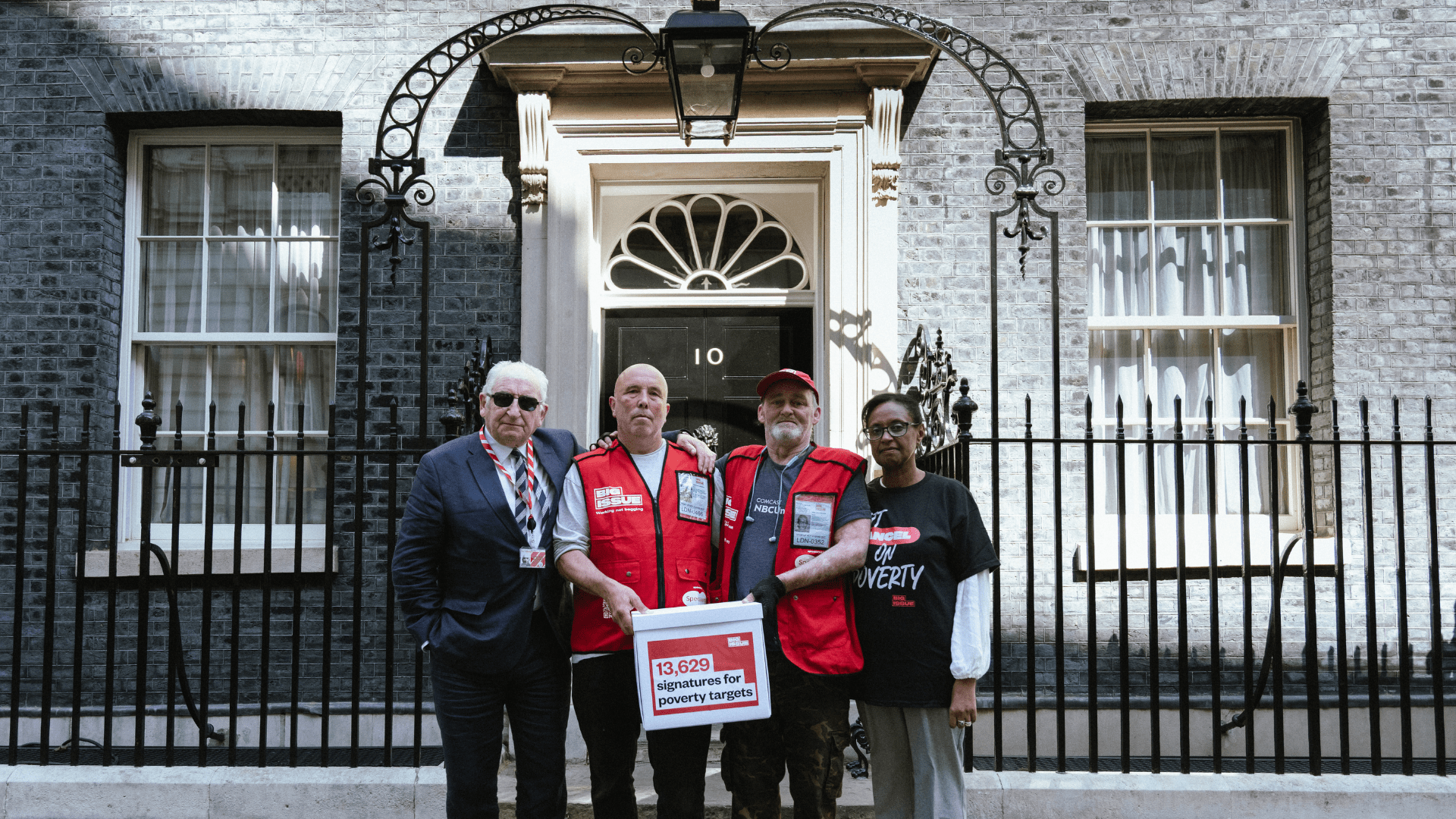
YouGov’s polling was commissioned by the Big Issue as its founder Lord John Bird led a group of vendors and campaigners to Downing Street to hand-in a petition signed by more than 13,000 people calling for Westminster to set legally binding poverty reduction targets.
The leading social enterprise has been campaigning for the UK government to introduce mandatory, time-bound poverty reduction targets, highlighting the significant gap in progress between England and Scotland, where the devolved government has the target of reducing relative child poverty to 10% of Scottish children by 2030.
According to the Big Issue’s analysis of child poverty data, conducted in 2025[4], Scotland has seen a 12% drop in relative child poverty since 2018, while England and Wales has seen a 15% rise – a 27-percentage point gap in progress. Where 21,000 Scottish children saw their poverty lifted, 320,000 more English and Welsh children have fallen into poverty.
Keep reading the journalism that powers our mission
Register free to continue and learn more about the stories, campaigns and the support we provide, helping people facing poverty across the UK.
13,629 people have backed the Big Issue’s campaign by signing the petition, which was handed in to 10 Downing Street last week, ahead of the new parliamentary session beginning on 13 May.
Lord John Bird, the founder of the Big Issue and a crossbench peer, said: “With a new King’s Speech on the horizon, now is the time for the government to hear our demands and introduce legislation to create mandatory poverty reduction targets.
“We cannot accept goodwill in place of real change – we must demand sustained, legislative action. Let us not look back and regret another missed opportunity. The time has come to stop simply managing poverty and to begin ending it.”
Advertising helps fund Big Issue’s mission to end poverty
You can read the full report on how Big Issue proposes establishing poverty reduction targets at bigissue.com/poverty-zero.
[1] 2,140 UK adults were surveyed by YouGov between 15th and 16th April 2026
[2] https://insidetime.org/comment/inside-politics-reform-and-greens-set-to-shine-in-may-elections/
[3] https://www.bigissue.com/campaign-with-the-big-issue/poverty-zero/
[4] Analysis of the child poverty rates come from the Department for Work & Pensions’ official statistics: Children in low income families: local area statistics 2014 to 2024, Department for Work & Pensions, published 27 March 2025
Ends
Advertising helps fund Big Issue’s mission to end poverty
Press Contact: James Barker, PR & Communications Manager for the Big Issue Group james.barker@bigissue.com / 07564 328307
NOTES TO EDITOR
All figures, unless otherwise stated, are from YouGov Plc. Total sample size was 2,140 adults. Fieldwork was undertaken between 15th – 16th April 2026. The survey was carried out online. The figures have been weighted and are representative of all UK adults (aged 18+).
Respondents were asked “Which of the following parties, if any, do you think would be best for reducing the number of people in poverty in the UK?”:
- Labour Party: 15%
- Conservative Party: 8%
- Liberal Democrats: 6%
- Reform UK: 11%
- Green Party: 15%
- Another party: 3%
- None of these: 19%
- Don’t know: 23%
Respondents were also asked: “Thinking specifically about households were at least one adult is in work, how much responsibility, if any, do you think the following should have for ensuring they do not fall below the poverty line?”
• The UK government:
o A great deal of responsibility: 34%
o A fair amount of responsibility: 44%
o Not very much responsibility at all: 14%
o No responsibility at all: 3%
o Don’t know: 6%
• Employers:
o A great deal of responsibility: 22%
o A fair amount of responsibility: 49%
o Not very much responsibility at all: 18%
o No responsibility at all: 4%
o Don’t know: 6%
• The individuals / households themselves:
o A great deal of responsibility: 41%
o A fair amount of responsibility: 47%
o Not very much responsibility at all: 5%
o No responsibility at all: 1%
o Don’t know: 5%
Advertising helps fund Big Issue’s mission to end poverty
Further insights:
- 24% of London respondents pick the Greens as best placed to reduce poverty – the highest of any region – compared to just 19% for Labour.
- In Wales, respondents were slightly less likely to pick Labour as best placed to tackle poverty than the national average (14%, compared to 15% nationally), and more likely to pick Reform than the national average (13%, compared to 11% nationally).
- Only 37% of people who voted for Labour at GE2024 say they currently back them as the best party for reducing poverty.