'Who are you going to trust on social media? You can trust what you hear at Jodrell Bank'
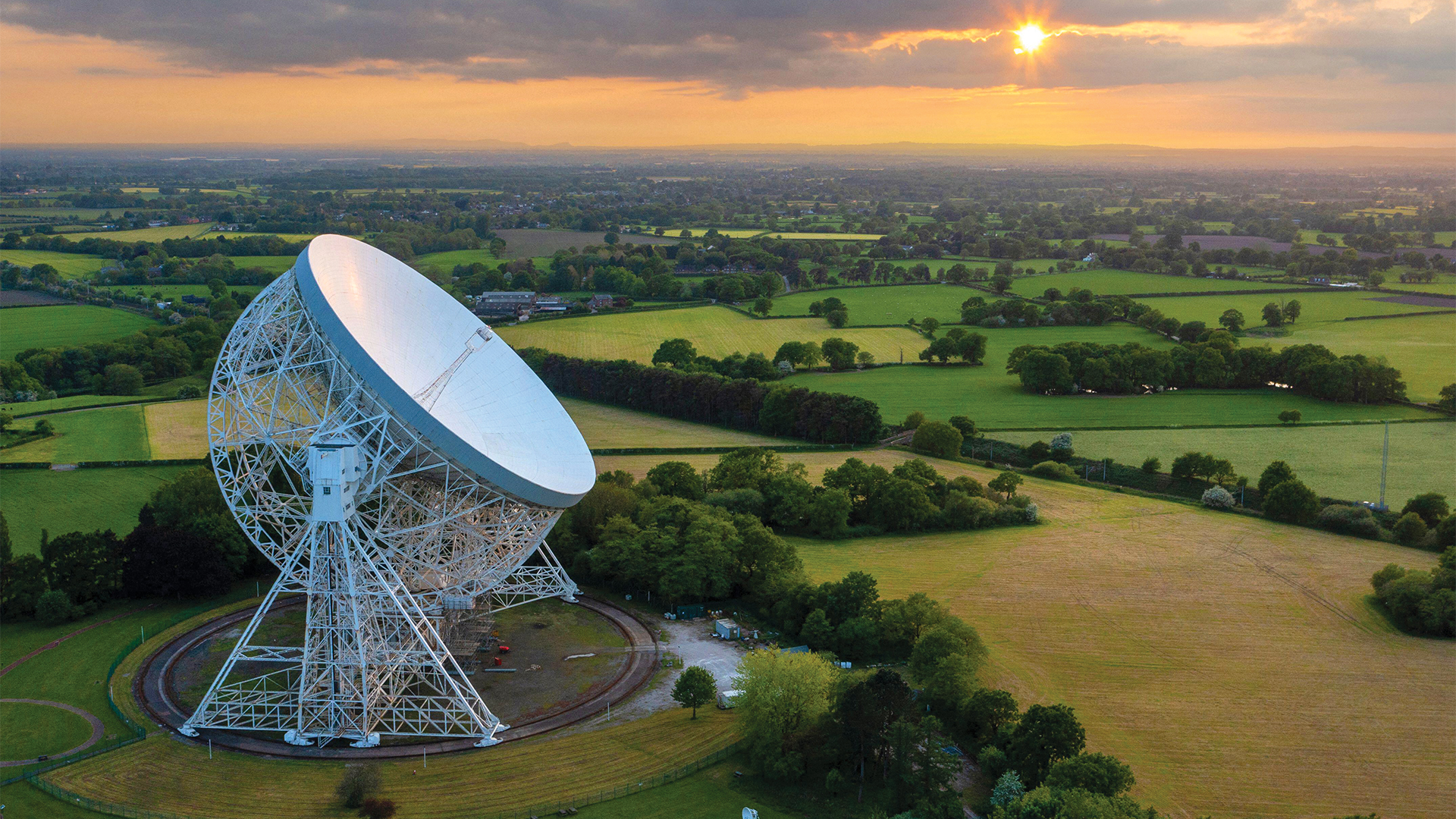
Jodrell Bank’s Lovell Telescope is the largest of seven UK telescopes that make up the e-MERLIN network. It is set to lose the entirety of its funding in 2028
by: Brontë Schiltz
11 Aug 2026
Jodrell Bank's Lovell Telescope. Image: Tom McAtee / Alamy
Share
On 10 July, I arrive at the gates of Jodrell Bank Observatory, just outside of Manchester. I’m here with three other writers taking part in a collaboration between publisher Comma Press and a team of astrophysicists.
A sign at the gate requests that you turn off your phone – the Lovell Telescope is sensitive enough to pick up a phone signal on the moon.
We spend the day with a team of researchers who are deeply passionate about their field. They show us everything from the Jodrell Bank Centre for Engagement (JBCE), filled with school children and adults in equal states of awe, to the Faraday cage (mercifully cool on a scorching day), all black towers and blinking lights, like something out of Black Mirror. “Is this your computer?” I ask Professor Simon Garrington, who replies, “This is our internet.”
Jodrell Bank’s Lovell Telescope is the largest of seven telescopes scattered around the UK that make up the e-MERLIN network. The group’s researchers collect more data than is stored on the entirety of the UK’s internet, requiring them to create their own.
“We publish 70 papers a year in academic journals. So many of the fundamental techniques of radio astronomy have been developed here and the e-MERLIN is the culmination of this. And we’re still developing techniques,” says Professor Garrington.
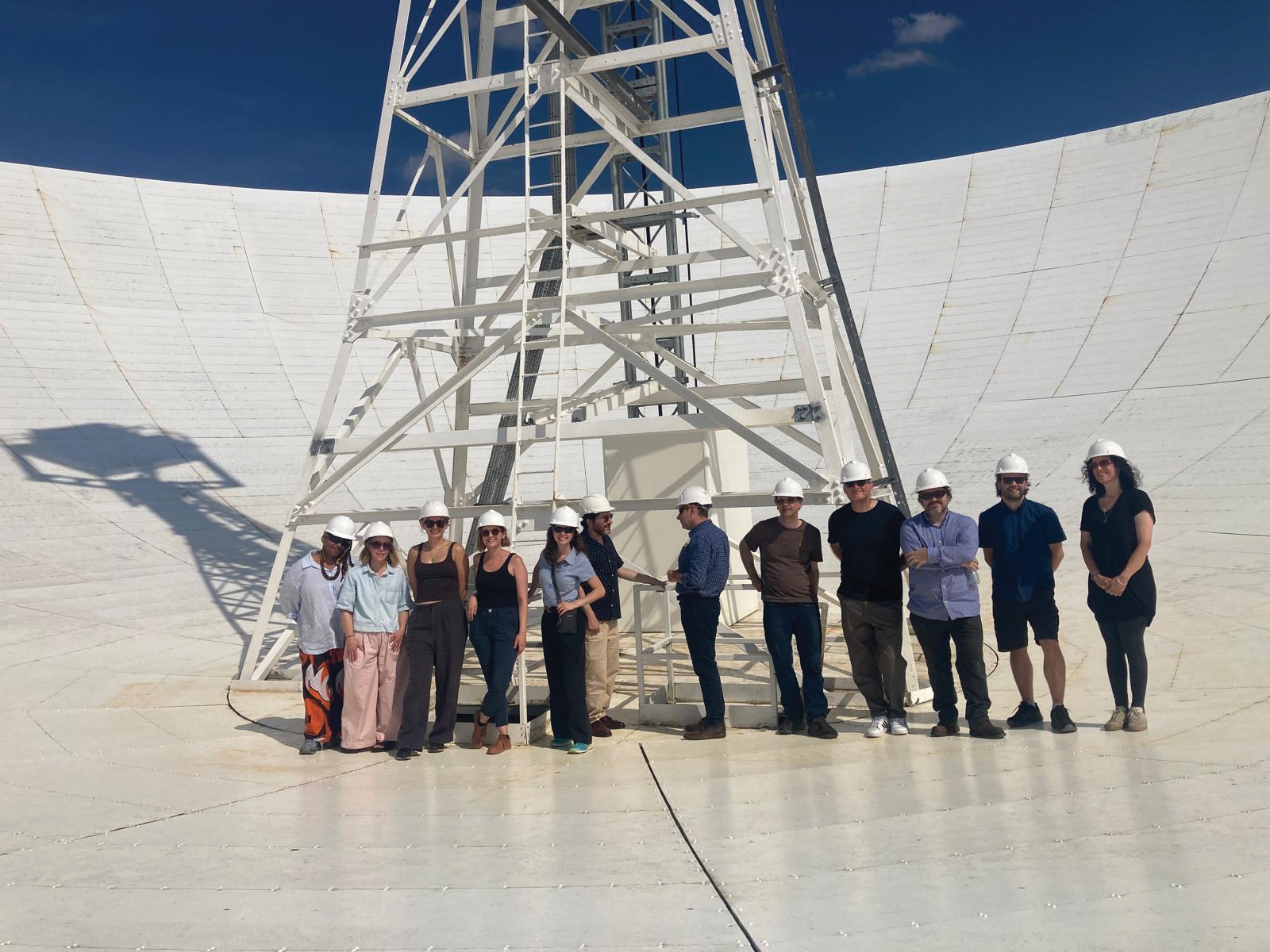
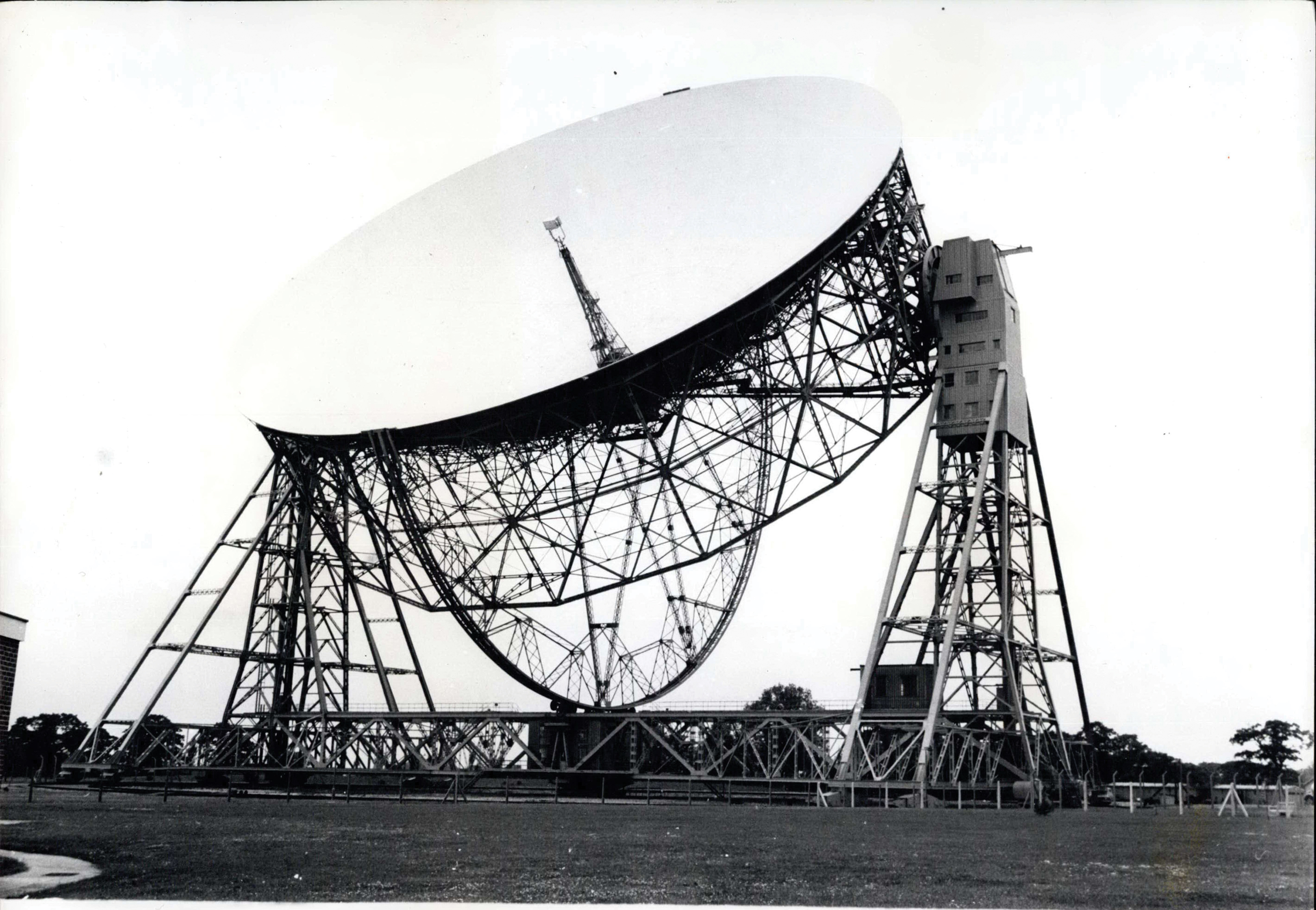
Our tour guides even halt the telescope for us so that we can walk across its surface, 250ft above the ground. Our climb is delayed until the afternoon as engineering staff are performing maintenance work. They later explain that so much work has been undertaken on upgrading the telescope, which was first completed in 1957, that it is essentially an entirely new piece of equipment.
Advertising helps fund Big Issue’s mission to end poverty
Advertising helps fund Big Issue’s mission to end poverty
Brontë Schiltz (fourth from left) and the tour group take a walk on the Lovell telescope’s surface at Jodrell Bank. Image: Supplied
Contrary to claims that it’s a legacy artefact, it is state-of-the-art. Professor Garrington says there is currently a team working on how to improve the cost and energy efficiency of the cutting-edge cooling equipment that allows them to reduce the noise of readings, gathering the most accurate data of our universe ever recorded.
Less than three weeks after our visit, the BBC will report that the e-MERLIN network is set to lose the entirety of its funding in 2028 following a decision by the Science and Technology Facilities Council (STFC), part of UK Research Innovation (UKRI).
Professor Garrington tells me this will be devastating for scientific research. “The e-MERLIN network is 200km across, and that span allows it to make images at radio frequencies of things in space with a very high level of detail,” he says. “In fact, the level of detail in the radio pictures we make matches the detail in optical images from the Hubble Space Telescope or infrared images from the James Webb Space Telescope. And that’s very important, to be able to layer one of those images on top of the other and really understand the physics of what’s going on.
“We are not an experiment to answer a single question,” he continues. “We are a facility that addresses a huge range of scientific questions that STFC have stated are fundamental frontier physics questions. And they range from activity on the sun and in the solar plasma between the sun and Earth to how planets form around young stars, the impact of black holes, supermassive black holes at the centres of galaxies, the distribution and nature of dark matter and dark energy, fundamental physics, even tests of Einstein’s general theory of relativity. The list is huge.
“There are thousands of scientists in the UK and around the world who use e-MERLIN. Almost every university astrophysics group in the UK uses e-MERLIN. We are an open facility, and we receive applications from all over the world. In the last round, we had a record number of proposals, so we’re in even more demand than we’ve ever been. Typically the demand exceeds what we can supply by a factor of four.”
Read more:
Advertising helps fund Big Issue’s mission to end poverty
Without the network, we lose eyes on the cosmos. “The big increase is in people wanting to do very rapid responses to discoveries of exploding stars or stars falling into black holes – these sort of things where the universe changes as we watch,” Professor Tim O’Brien says. “If people want to catch these things… e-MERLIN is ideal for that.”
“Those people tell us we’ve become the instrument of choice for that kind of work,” Professor Garrington adds. “It’s a field dominated by younger scientists, and we have developed a mode where we can react very quickly, make those observations, produce images from those observations very quickly, and work with them so they can get the data quickly. It’s a dynamic subject for a dynamic universe.”
Replacing this capacity would be enormously expensive. “To build a new telescope without any receivers or any electronics, like the Lovell Telescope, would cost £100 million,” says Professor Garrington. UKRI could fund Jodrell Bank for 35 years for the same cost.
UKRI have defended the cuts on the basis that JBCE will remain open, but Jodrell Bank’s physicists say this betrays a fundamental misunderstanding of their role in communications. “When people visit Jodrell Bank, they’re visiting a working science facility,” says Professor O’Brien, “and we’re a trusted source in that sense. Who are you going to trust when you read all these things on social media? But if you come to Jodrell Bank, you can trust what you hear there. I think that’s our role, and we’ve played that very, very well for decades.”
The decision was based on a need to prioritise funds to support postgraduate and researchers, who have been leaving the field or the country in unprecedented numbers due to a lack of domestic opportunities. But for many young physicists the decision feels misguided.
“For early-career researchers, the cuts leave our future in UK science uncertain,” says PhD candidate and lecturer Louisa Mason. “During my PhD, I have worked with and learnt from incredible technical staff, academics and fellow students. As a Mancunian, Jodrell Bank has been a personal inspiration to me, remaining at the cutting edge of radio astronomy and a beacon for science in the North West. I know many others in the department and beyond that feel the same way.”
Advertising helps fund Big Issue’s mission to end poverty
“It’s worth bearing in mind that the majority of the cost of those projects [being cut] is actually people,” adds Professor Garrington. “We really appreciate that that pipeline of new scientists is not being cut too deeply, but on the other end, all those projects are run by people whose jobs are now very, very much at risk.”
The cuts will also affect Britain’s contribution to science on an international scale. “What’s been cut as well is our contribution to the wider European network of radio telescopes, of which we were a founding member, and has often been held up as a great example of international cooperation in science,” says Professor O’Brien. “That just looks very strange to our international partners.”
UKRI is investing in Square Kilometre Array (SKA) observational infrastructure currently under construction in Australia and South Africa, but Professor Garrington emphasises that Jodrell Bank, whose site is also home to SKA Observatory headquarters, complements this research.
“We can either add our telescopes and strengthen that global network, whose headquarters are right next to the telescope, so those international scientists can come to SKA and look out the window and see the Lovell Telescope observing with that global network. Or they can stop our funding, and those scientists can look out the window at the world’s largest disused radio telescope and know that the UK is taking no part in these observations.”
A spokesperson from UKRI said: “We recognise the strength of feeling about Jodrell Bank and the e-MERLIN network, and the contribution they have made to UK science. The achievements of the scientists, engineers and staff are widely respected across the research community. Jodrell Bank Observatory will continue to be home to a range of scientific and public engagement activities, led by the University of Manchester. The University has also confirmed that the Jodrell Bank Centre for Engagement is not funded by STFC and will remain open to visitors.
“STFC’s decision, which takes effect from 2028, follows a difficult prioritisation process… and reflects the need to focus investment on the facilities and infrastructure that will underpin future scientific capability.
Advertising helps fund Big Issue’s mission to end poverty
“UKRI remains committed to maintaining a world-leading research and innovation system within the funding available.”