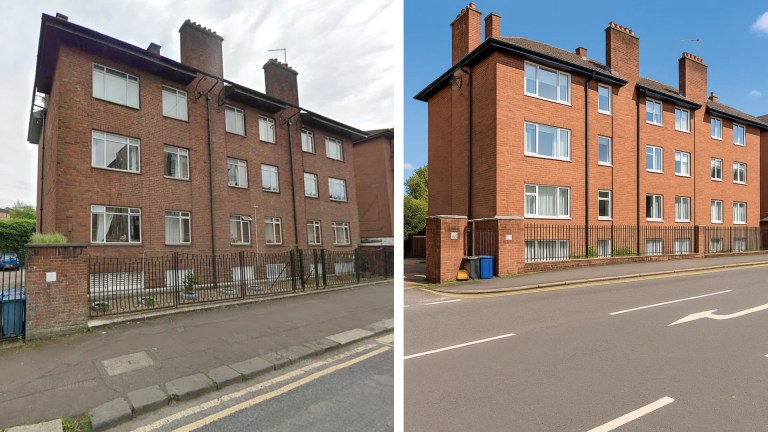
What is the new Conservative policy on social housing?
Under the plans, single social housing tenants who are not UK, Irish or EU citizens with settled status would lose their right to remain in their homes. The same would apply to couples where neither partner qualifies.
For future tenancies, foreign nationals would be barred from becoming social housing tenants, with eligibility limited to UK and Irish citizens and EU citizens with settled status.
The Conservatives claim the policy would free up around 230,000 homes for “British families”. Evicted tenants would be given six months to find private accommodation.
Keep reading the journalism that powers our mission
Register free to continue and learn more about the stories, campaigns and the support we provide, helping people facing poverty across the UK.
The “divisive plans” could mean evicting “thousands of families and pensioners who have lived in them for decades,” said Sarah Elliott, the chief executive of housing charity Shelter.
“It is completely senseless to ruin people’s lives, drive up homelessness and put extreme pressure on councils. This policy does nothing to deliver new social homes, which is what we desperately need.”
Is it a new policy?
No. The Conservative proposal is remarkably similar to one announced by Rishi Sunak in 2024, and echoes a policy announced by Reform UK earlier this year.
Advertising helps fund Big Issue’s mission to end poverty
Labour was quick to point this out, describing it as “an unserious, unworkable proposal, copied from Reform”.
Reform’s policy did go further. It would give foreign nationals already living in social housing just three months to find private accommodation. They would also not exempt EU nationals with settled status.
Indeed, the idea that migrants are taking homes from British people is no longer confined to the political right.
Earlier this year, home secretary Shabana Mahmood used access to welfare and social housing to justify Labour’s plans to make some migrants wait longer before applying for settlement.
In a Guardian op-ed, she argued that low-skilled workers would otherwise be able to apply for welfare and social housing sooner, placing “yet more pressure on already stretched public services”.
The article was later amended to clarify that settlement only makes someone eligible to apply for welfare and social housing. It doesn’t give them automatic access.
Advertising helps fund Big Issue’s mission to end poverty
Who qualifies for social housing?
Most new migrants cannot access social housing at all.
People who come to the UK on work or study visas generally have “no recourse to public funds”, meaning they cannot claim most benefits or get help with housing. Asylum seekers cannot apply for council housing either while their claim is being processed. There are (extremely) limited exceptions, including for some people fleeing domestic abuse.
Foreign nationals can qualify for social housing if they have settled status, refugee status or certain forms of humanitarian protection.
This isn’t an easy process and almost always follows years of living in the UK. To qualify for indefinite leave to remain, for example, most people must have lived lawfully in the UK for at least five continuous years and meet a range of other requirements, including passing English language and Life in the UK tests.
Even with refugee status, households cannot ‘jump the queue’ and have to join more than 1.3 million households on social housing waiting lists in England.
“Access to social housing is tightly regulated,” said Rachel Williamson, Chartered Institute of Housing’s director of policy, communications and external affairs, “and evidence shows that only a minority of new social housing lettings go to non-UK nationals, with most applicants facing long waits regardless of nationality.”
Advertising helps fund Big Issue’s mission to end poverty
How many ‘foreign nationals’ currently live in social housing?
British people already make up the vast majority of social housing tenants.
In 2024-25, 88.5% of main householders – the person in whose name the social home is rented – were UK or Irish nationals, according to the English Housing Survey. Just 11.5% were non-UK or non-Irish nationals.
That amounts to an estimated 470,000 non-UK and non-Irish citizens living in social housing.
These people are often the target of “scapegoating and anger,” said Lucy Mort from IPPR. But, she said, they are lawfully living in the UK and are entitled to social housing if they meet the eligibility criteria and need it.
Read more:
“When people do get into social housing, they’ve probably been on a very long waiting list, and they’ve had to demonstrate a really, really high level of need,” added Mort.
Advertising helps fund Big Issue’s mission to end poverty
“These are people who are lawfully resident in the UK, they are people who typically will have their indefinite leave to remain… they have a right to be here. They are often paying taxes. They are often working.”
Almost two-thirds (65%) of employed social housing residents work in key worker occupations, including health and social care, education, retail and transport.
Is the Conservatives’ plan workable?
There would be serious difficulties involved, said Williamson. “Proposals to ban foreign nationals from social housing raise significant practical, legal and operational questions.”
Firstly, the policy would likely face a legal challenge.
The Equality and Human Rights Commission has previously warned that social housing providers discriminating against applicants on the basis of nationality may be breaking the law.
When Big Issue analysed the Tories’ previous “British homes for British workers” policy in 2024, housing solicitor Giles Peaker made the same assessment.
Advertising helps fund Big Issue’s mission to end poverty
But even if the policy survived a court challenge, there is another obvious question: where would the people being evicted go?
“It just creates more people who are going to be in crisis,” said Mort. “A policy that creates more homelessness and doesn’t create any more homes doesn’t feel like a very good housing policy.”
Is there an alternative solution?
The Tories are right about one thing, said Mort: Britain is desperately short of social homes. Around 1.3 million households are currently on social housing waiting lists in England. The number of households in temporary accommodation reached a record high of 135,580 at the end of March 2026.
But that shortage “is not caused by migrants in social housing,” she said.
“We know what the problems are. The fundamental problem is we don’t have enough social homes. Policies like Right to Buy have completely depleted the stock that we do have, and therefore we’ve got people just languishing in temporary accommodation.”
The alternative, she argued, is to build more homes.
Advertising helps fund Big Issue’s mission to end poverty
Andy Burnham has said he wants his Labour government to “oversee the biggest council housebuilding programme since the postwar period”.
It would be a big task. His predecessor Keir Starmer promised to build 1.5 million new homes over the course of a parliament – a target Labour is already struggling to meet.
Burnham has promised to use vacant public land, and has focused on council homes rather than private developers. But he still faces a big challenge.
Until there is more social housing to go around, policies about ‘foreign nationals’ using up housing will dog British politics. It’s easier for populist parties to scapegoat and create division by carving up a finite resource than taking the more difficult approach of coming up with ways to build more social housing.
Do you have a story to tell or opinions to share about this? Get in touch and tell us more.
Change a vendor’s life.
Advertising helps fund Big Issue’s mission to end poverty
Buy from your local Big Issue vendor every week – and always take the magazine. It’s how vendors earn with dignity and move forward.
You can also support online:
Subscribe to the magazine or support our work with a monthly gift. Your support helps vendors earn, learn and thrive while strengthening our frontline services.
Thank you for standing with Big Issue vendors.