'Extreme heat is not just a climate issue. It is a housing crisis too'
As cities become hotter, many homes no longer provide a place of safety. Melting Metropolis is a project that combines histories, geographies and research to highlight stories around urban heat islands
Heatwave in London circa 1935. Image: Topical Press Agency / Getty
Share
Extreme heat is a global crisis, but it has a British slant. British colonialism and the industrial revolution set the world on the path towards a fossil-fuelled greenhouse. Chemist Luke Howard identified the urban heat island effect in the 1820s (whereby cities absorb and retain heat more than the countryside). And Victorians worried about summer diseases and overheating in growing cities. But in recent times, we have not taken heat as seriously.
Heatwaves are sometimes described as ‘silent killers’. And heat is a public health crisis that disproportionately affects vulnerable, old, and marginalised communities and is compounded by other crises, including those caused by a degraded public sphere after years of austerity and the housing crisis.
Britain is extremely ill-equipped to cope with heat. We lack the behaviours and lifestyles, as well as housing and other infrastructures, needed to healthily weather heatwaves.
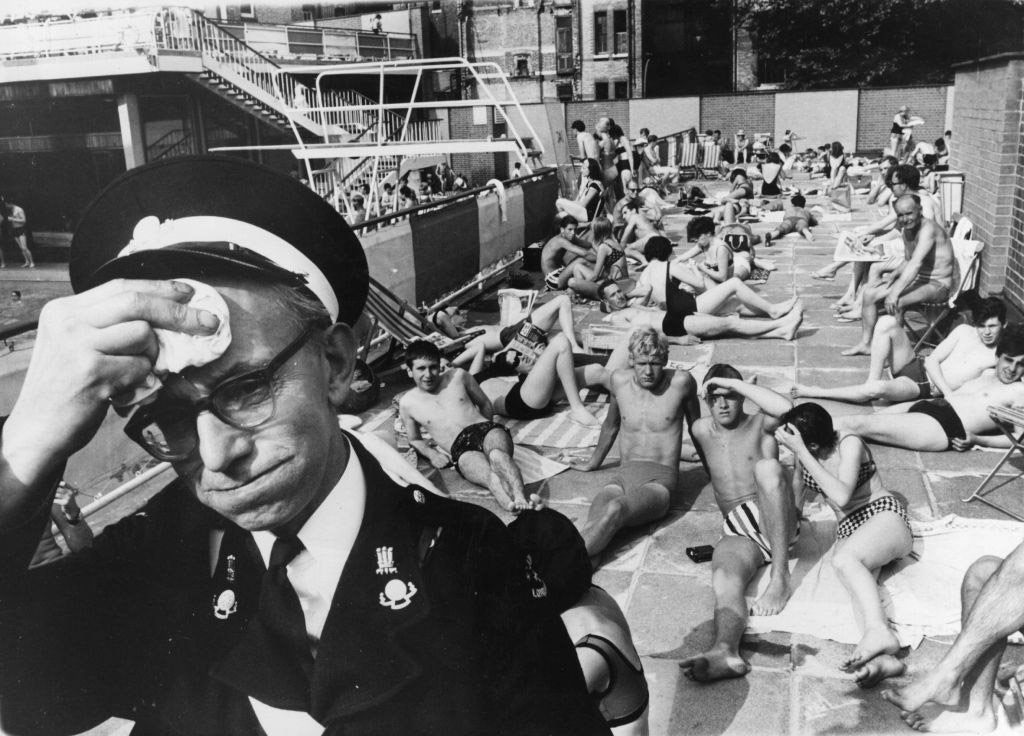
In the 20th century, Britons saw a lack of heat as more of a problem than an excess. They lamented their grey and wet summers, while worshipping the sunshine. The interwar period saw the arrival of lidos and Vitamin D, while beach cultures, suntanning, and package holidays turned us into a nation of sunseekers after World War II. We demand fun in the sun during summer and refuse to take the season seriously.
Heat is therefore a cultural crisis, as well as a public health and technical one. Our 20th-century mindsets are not equipped for 21st-century climates.
Melting Metropolis addresses this issue by exploring the histories and geographies of heat in London, as well as Bristol, Liverpool, New York, Paris, and Port-of-Spain. From the outset of this Wellcome research project, based at the University of Liverpool and Queens College, City University of New York, we chose to integrate research with community and creative public engagement to make heat real and embodied. Lived experiences and sensory approaches are vital as they reveal how heat has been and is increasingly present in our lives.
Advertising helps fund Big Issue’s mission to end poverty
Advertising helps fund Big Issue’s mission to end poverty
As our climate changes and cities become hotter, many homes no longer provide a place of safety. Londoners have told us how their homes trap heat day and night, with temperatures staying stubbornly high, leaving people unable to sleep, stay healthy or think clearly. One person explained that there is “no respite for a second” once temperatures rise in their home, while another compared stepping inside to being hit by a wall of hot air.
Many people have developed the knowledge and resourcefulness needed to provide a degree of comfort during hot weather, using blinds, fans, water and ice. But climate breakdown means they are being pushed beyond the limits of their ability to cope with extended periods of very hot weather. Overheated homes worsen existing health conditions, increase anxiety and leave people socially isolated.
Continue reading for free
Registration is free and takes less than 30 seconds.
Our supporters make Big Issue’s work possible. Join us to see the impact we’re having together and discover more ways to help people facing poverty access income, opportunity and support.
For people experiencing homelessness, the situation is even worse. One person described how: “You can’t sit in a tent when it’s hot. I woke up the other morning, unzipped the tent, I couldn’t breathe, you know. Sometimes it plays on my chest because the fluctuations in the weather, where it’s been colder and then hotter and then it’s been wet.”
Holborn Oasis pool, July 1964. Image: Keystone / Getty
Londoners’ experiences of very hot weather show that extreme heat is not just a climate issue. It is a housing crisis too. From overheated buildings to life on the streets, the ability to keep cool and safe is deeply unequal. Under the summer sun, urban communities feel the heat.
A central part of the Melting Metropolis project is its community engagement programme. From the outset, it was essential to us that our work extended beyond simply doing research on the effect of urban heat. We wanted to work alongside communities, commissioning stories, co-designing events, and learning together.
Advertising helps fund Big Issue’s mission to end poverty
Community storytelling events are taking shape on the concrete streets of Somers Town, London, as well as in Jamaica and Newtown Creek, New York.
Change may be inevitable, but it is rarely comfortable. The question is who gets to determine its direction. Across Melting Metropolis, we are searching for stories that do more than describe the future. We are searching for stories to help us imagine it, shape it and claim a place within it.
As the artist working with Melting Metropolis, my aim has been to amplify and carry into the public realm the ‘hidden’ histories and under-heard testimonials of those most vulnerable to the urban heat. Early in my collaboration with researchers, I developed an artist and historian-led workshop, ‘Drawing Heat’, where local groups explored their neighbourhoods – armed with chalk, pencil and paper – to mark-make observations of how the sun’s heat moves through the urban landscape and how their own bodies respond to heat intensified by their city’s materiality and geometries.
While grounded in the present moment, these walks also carried us into the past, highlighting moments in which human design and developments have built the sun’s heat into our cities, exacerbating thermal inequalities across neighbourhoods.
These workshops evolved into two sister artworks now touring; the sculpture My Body is a Sundial and the multidisciplinary performance Stand of the Sun. While the sculpture transforms the body into a barometer as a way of exploring the body not only as a record of solar time but also of solar intensity, Stand of the Sun offers a new ritual for a time of climate change.
Advertising helps fund Big Issue’s mission to end poverty
Through dance, music and storytelling, the performance is guided by an imagined conversation with the sun as it travels through cities and bodies, interwoven with the words of Londoners describing the physical and emotional toll of living in cities that hold the sun too close.